
Where Wall Street is Meeting Venture

WHERE WALL STREET IS MEETING VENTURE

Over the last few newsletters, we have introduced our updated investment thesis focused on the arrival of an Autonomous Digital Economy powered by the convergence of Internet, AI/Agentic, and Blockchain technologies and innovations. We have shared perspectives from both Silicon Valley and London and kept you abreast of what we are hearing from leading early and mid-stage venture capital investors that we are partnered with, including many of the world’s foremost AI/Agentic and Blockchain fund managers.
With this newsletter, we are adding in another perspective: from the public market and late-stage investors of Wall Street. Going forward, once a quarter, we will share the News from New York as Wall Street meets venture and attempts to access some of the value that is increasingly being created and captured in the private, not public, markets. Each issue will cover some aspect of late-stage venture, secondaries, and/or pre-IPO/IPO positioning that we believe is important for you, our investor community, to be know.
In this first edition, we focus on one of the hot topics in Manhattan and Wall Street right now - the arrival of the world’s most successful and most highly valued AI companies as they begin their going-public processes, and, in the case of SpaceX, it's debut as a public company.
The Venture Mindset
For those of our readers who have a venture mindset, the bullet points that follow are obvious:
Most start-ups fail, and even the best venture investors see roughly 60% failure, 30% outcomes in the 1x to 5x range, and then only 10% of investments reach 5x or better but drive the lion's share of returns. As a result, diversification is a requirement, not a nice-to-have.
Eventual exits are, 90% of the time, acquisitions and rarely going-public events, so good venture capitalists build companies to sell, and then swarm those that can eventually be public as emerging category leadership is proven.
The importance of privileged access through proprietary deal flow and partnerships with other leading investors is paramount.
Deep due diligence is critical before, during, and after venture capital flows into the hands of entrepreneurs.
Hands-on company building and support through product launch cycles, go-to-market expansion, and never-ending fundraising rounds as growth capital is required.
All of these aspects of innovation investing are most probably deeply ingrained in the way you think about your long-term venture investing decision-making.
Seeking Alpha in Concentrated Trades
Conversely, sitting here in Manhattan, and surrounded by the world’s largest and most important financial ecosystem, it is a very different calculus. Wall Street is more about trading and finding edge than it is about spending a decade positioning for future outcomes. Here most of the talk around the table is about finding promising trades ahead of the crowd, and capitalizing on them with large concentrated bets, often much bigger bets than most venture capitalists would ever consider making into a single portfolio company.
While the traditional markets that were the stalking ground for traders in search of edge were, of course public, more recently, Wall Street has become enamored with the wealth creation of the private markets. There have been many drivers of this shift, but perhaps the most important has been the clear and obvious realization that most of the public market alpha of the last two or three decades has been driven by the innovation-focused companies including the FANGs (Facebook, Amazon, Netflix, Google (Alphabet) and a handful of others including Apple, Microsoft and most recently Nvidia).
Today, it seems, everyone on Wall Street is asking the same question: how can we get into the next wave of FANGs but while they are in the late stages of their private lives? - clearly before going public, but still hard to access, and hopefully investable at discounts to their future public valuations.
Three Companies, One Concentrated Bet
This mindset has, in this cycle, concentrated around an unusually small set of names: Primarily the LLMs that have declared their intent to be public (Anthropic, OpenAI, and SpaceX with XAI embedded within), as well as perhaps another one or two score other late-stage companies from Anduril to Zipline and a bunch in between.
This year, the clamor for shares in each of the three LLMs has been the most talked-about issue I am hearing in Manhattan. Sometimes through multi-layered vehicles, with unclear combined costs and with unexplored counterparty risks. The money has still flowed in, and valuations have gone into uncharted territory for late-stage pre-public companies.
No longer unicorns and decacorns, but now centicorns and trillion-dollar companies.
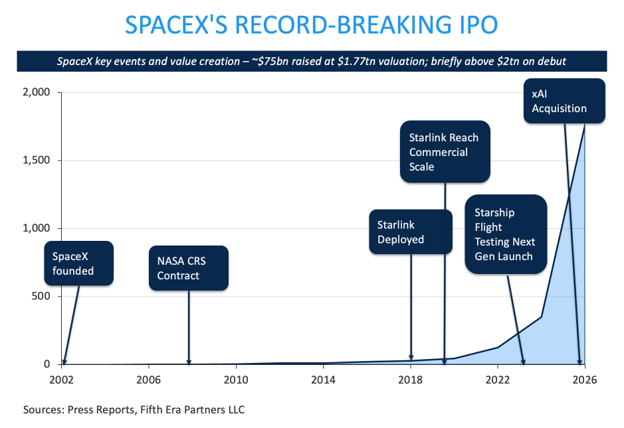
SpaceX has already completed its IPO, pricing in mid-June at a valuation north of $1.7 trillion and as Exhibit 1 demonstrates, it was not until Starlink became a clear disruptor to the entire global communications industry, and SpaceX acquired xAI and expanded its focus from getting to Mars, to "building the systems and technologies necessary to make life multiplanetary, enabling human life on other planets and extending the light of consciousness to the stars" (SpaceX Mission Statement) that its valuation really took off.
Exhibit 1. SpaceX’s Record-Breaking IPO
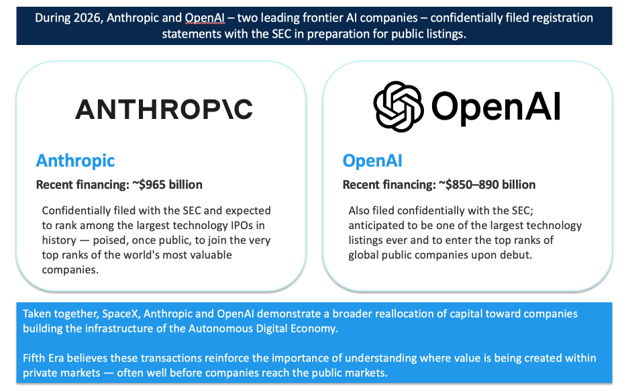
Meanwhile, not to be left behind, the other two leading US LLMs also got into the game. Anthropic confidentially filed its S-1 on June 1, 2026, following a ~$65 billion Series H round at a $965 billion valuation; OpenAI filed about a week later, and has more recently signaled it may push its listing into 2027 rather than list in the shadow of a volatile market - Exhibit 2.
Exhibit 2. Anthropic and OpenAI IPO Aspirations
The hundreds of billions flowing into these three companies, much of which has originated here in Wall Street from the largest of allocators, has been activated by a singular idea:
The majority of the value creation in this cycle has already happened in private markets, well before any of these companies will trade publicly. By the time a company like these lists, most of the multiples expansion will be behind them.
So access to these three companies in the late stage of the private markets is where the capital has flowed, in wave after wave amounting to more capital than the entire US venture capital industry invests in every stage, and in every company it backs throughout an entire year.
AI Is Steepening the Power Law
Venture has always been a power law business, where a small number of outlier investments generate the majority of returns, as we previously noted.
However, what's changed is how steep that curve has become in AI/Agentic specifically.
According to recent research from Commonfund, the top 1% of venture-backed exits since 2023 account for roughly 80% of total exit value (45% even excluding SpaceX's IPO alone), up from just 17% in 2005–2010 and 34% in 2017–2022. The same research found the average valuation of the top five private companies has grown roughly 17x since 2015, and that AI/Agentic now absorbs the large majority of U.S. venture dollars.
CommonFund goes on to propose the following practical implication for allocators:
Manager and access selection matter more than they used to, not less
Being broadly diversified across "AI exposure" is no longer sufficient if the bulk of the return sits with two or three companies
Getting into the right rounds, early, is doing more of the work than it has in prior cycles
Music to our ears. Follow this link to read more of CommonFund’s findings.
Diversify Early, Concentrate as Signal Emerges
This has always been our central thesis at Fifth Era. Specifically, we have told you for more than a decade that our investment strategies are as follows:
Early stage - diversified. We invest broadly at the seed and early stage by partnering with the best pure-play venture fund managers in each area of innovation through a fund-of-funds approach. We are explicitly prioritizing access over concentration at this point in a company's life, since which companies will separate from the pack is genuinely hard to call this early; however, the top quartile investors persistently do a better job than anyone else at getting the future unicorns into their nets.
Mid stage - concentrated, access- and signal-based. As companies establish themselves, we follow on selectively into the names showing the clearest signal, informed by the access and relationships built at the early stage. This strategy of direct, signal-based investing into the emerging category leaders is what we offer you through our coinvestment program.
Pre-IPO / secondaries on a selective basis. For allocators seeking exposure to later-stage private names ahead of a public listing, we selectively participate in secondary transactions where they're available.
It is rewarding to see others such as CommonFund coming to the same conclusions based upon their extensive research into the most recent cycle of value creation in the exponential technologies that we also focus on.
Implications for Investors
With SpaceX shares showing pricing volatility and significant unlocks coming up soon, Anthropic still tracking toward a fall listing, and OpenAI weighing a delay into 2027, the next several months should offer a useful test case for how private-market pricing translates into public-market pricing for the leading LLMs, which are perhaps harbingers of the coming wave of AI/Agentic and Autonomous Digital Economy going-public events.
However, we think that Wall Street is more right than wrong, although like often in the past, the scale of their capital investment can sometimes create boom-bust cycles. The part they are clearly getting right is that the majority of the world’s value creation over the next few decades is likely to be captured in the private markets by those who back the innovators that move us into an Autonomous Digital Economy.
As we wrote in our last newsletter:
In our view, Artificial Intelligence, including Agentic, is rapidly becoming one of the defining investment themes of our generation. Yet identifying the companies most likely to create enduring value requires far more than recognizing the importance of AI itself. It requires access to exceptional founders at the earliest stages of company formation and partnership with investors possessing the technical expertise, industry networks, and experience to evaluate breakthrough technologies before they become widely recognized.
Through our Fifth Era AI investment strategy, investors gain diversified exposure through a single professionally managed vehicle. Rather than relying on one investment philosophy or one geographic market, we provide access to a carefully curated portfolio of specialist AI managers, each bringing unique expertise across foundation models, enterprise AI, infrastructure, robotics, industrial AI, healthcare, AI safety, and frontier technologies.
For investors seeking long-term participation in the continued evolution of artificial intelligence, our objective is straightforward: provide access to experienced managers, innovative founders, and compelling opportunities across the AI ecosystem.
Do not hesitate to reach out to us if you want to discuss our AI investment strategy and how you can participate in it by contacting our team at IR@fifthera.com.
Thank you for reading,
Winifred Pritchett
Head of Capital Formation, New York
ABOUT FIFTH ERA
'Focused on Innovation'
Our firm believes we are entering a period of unprecedented innovation, which we call the Fifth Era, and every industry and business will be dramatically impacted. We focus on investing in these new innovations, especially private companies focused on the convergence of Internet, AI/Agentic and Blockchain technologies to shape an Autonomous Digital Economy. Our investment strategies construct portfolios of hard-to-access early stage funds and make concentrated direct investments into emerging category leaders during their mid and late stage investment phases. Fifth Era's investment strategies are now in their 13th year and to date we have invested in a combined portfolio of 1,500+ companies including 80+ unicorns. In the US we are a SEC registered investment advisor, in the UK a FCA appointed representative and our funds are registered in Switzerland.
Visit us at www.FifthEra.com to learn more.
Note: SEC Registration does not imply a certain level of skill or training.