
Rates Went Up. Private Valuations Went Up Anyway.

Rates Went Up. Private Valuations Went Up Anyway.
Last quarter we launched News from New York, our quarterly report on where Wall Street is meeting venture. We closed that first edition by saying the months ahead would offer a useful test case for how private-market pricing translates into public-market pricing for the leading AI labs.
Well, the test case arrived. Just not in the way most people here in Manhattan expected.
What does a rate hike actually mean?
The quarter began with everyone asking when the Fed would cut. Instead, on September 16, the Federal Reserve raised rates by a quarter point, to 3.75-4%. It was the first hike since 2023. By the end of September, the 10-year Treasury yield had closed at 5.29%, its highest close in more than two decades.
For those of our readers with a venture mindset, a rate hike matters in three ways:
Future profits are worth less today. A venture-backed company is valued almost entirely on profits it expects to earn years from now. The higher the interest rate, the less those distant profits are worth in today’s dollars.
Borrowing costs more. This bites hardest in AI infrastructure, where so much of the build-out is financed with debt. According to the Financial Times, AI-related debt issuance fell from $113 billion in June to $23 billion in September, and CoreWeave’s bond yields pushed above 15%.
Safe money competes for the same venture dollars. When a 10-year Treasury pays more than 5%, investors can earn a great deal without taking risk. So they demand more from every IPO and every private round.
Put simply, a rate hike should have cooled the private markets.
It didn’t. At least, not at the top.
US venture deal value reached a record $515.8 billion through the third quarter, and 82.7% of it went to AI, according to the PitchBook-NVCA Venture Monitor. Corporate investors accounted for a record 87.9% of AI deal value.
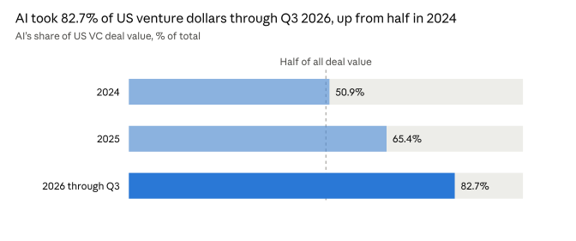
Source: PitchBook-NVCA Venture Monitor. 2024 and 2025 are full-year figures as reported in January 2026; 2026 is through September 30. PitchBook revises earlier years each quarter.
Sound familiar? Just as we wrote last quarter, the capital is not spreading out. It is concentrating, wave after wave, on the handful of names that look like category leaders. Q3 gave us four stories that show where that capital went, and why so much of the value it is creating is staying private.
1. Two Labs, Two Paths to Liquidity
Last quarter we told you that both of the leading US LLMs, Anthropic and OpenAI, had filed confidentially to go public. In Q3, they chose very different roads.
Anthropic: from leaked draft to public filing
Anthropic confidentially submitted a draft S-1 to the SEC on June 1. In late September, a draft leaked to Reuters, and in October, further sections reached the Wall Street Journal. Then, on October 26, Anthropic filed its S-1 publicly. It plans to list its Class A shares on the Nasdaq Global Select Market under the ticker ANT. The number of shares and the price range have not yet been set.
So, for the first time, we can work from filed numbers rather than leaks. According to early coverage, the public S-1 shows:
Revenue of $16.3 billion in the first six months of 2026, more than three times the $4.6 billion it generated in all of 2025
A net loss of $80.7 billion for the first half, the vast majority of it from accounting charges, following a $42 billion loss in 2025
$9 billion spent on AI infrastructure in the first half, more than the $7.3 billion spent in all of 2025.
Extensive risk disclosures, including the possibility that its models develop capabilities the company does not anticipate
About one-fifth of revenue comes from two customers
Plans to spend more than $450 billion on cloud computing in the years ahead, through deals with Amazon, Google, and others
A governance structure in which a trust can elect a majority of the board, which makes Anthropic a “controlled company” under Nasdaq rules
The S-1 covers results through June. Separately, at a closed-door investor meeting earlier in October, Anthropic reportedly told investors that Q3 revenue reached $16.8 billion.
The valuation conversation has been volatile. Anthropic’s Series H in May valued it at $965 billion. In August, the Financial Times reported that investors expected a listing at $2 trillion or more. By mid-October, Reuters reported that a figure of around $1.5 trillion was being discussed after third-quarter growth slowed. With the S-1 now public, reports point to a listing in mid-November that could raise as much as $100 billion, which would surpass the record SpaceX set in June.
The skeptics are loud too. Research firm New Constructs valued Anthropic’s equity at as little as $144 billion.
OpenAI: hold the price, wait for 2027
OpenAI went the other way. In August, it bought back roughly $7 billion of shares from current and former employees with its own cash. No outside buyers set a new price, and the valuation held flat at $852 billion, the first flat mark in a long run of step-ups.
OpenAI has since pushed its IPO to 2027. It is reportedly seeking to raise about $30 billion at a $1.2-1.5 trillion valuation, and reportedly told investors to expect about $50 billion of revenue this year, below earlier projections of $70 billion.
One caution before reading the chart: the two companies reportedly calculate annualized revenue differently, so their run-rate figures are not directly comparable. Quarterly revenue is the cleaner comparison.
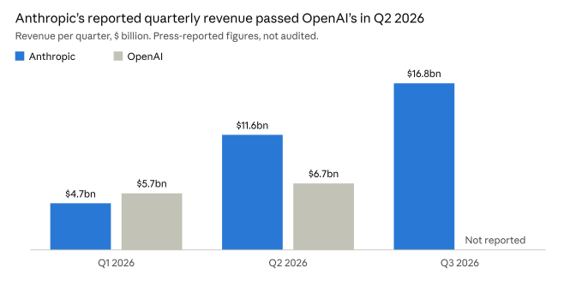
Source: Anthropic Q1, leaked draft S-1 (Reuters via Fortune); Q2, Axios; Q3, as reportedly told to investors (FT via Motley Fool). OpenAI Q1, The Information; Q2, Axios. Anthropic’s public S-1 reports $16.3 billion for the first half combined.
OpenAI has not reported Q3 revenue. Anthropic’s Q3 figure is what it reportedly told investors, not a filed number.
The window they are walking into
Renaissance Capital, which tracks US IPOs, counted 30 listings raising $32.8 billion in Q3. Strip out SK hynix’s $26.5 billion US offering, and the rest of the market raised just $6.2 billion. Renaissance’s IPO ETF, a basket of recently listed companies, returned -11.4% for the quarter against +2.4% for the S&P 500. That is the report card on how new public companies have been trading.
In early October, Nvidia-backed AI data center operator, Firmus, withdrew a listing that would have valued it at about $30.6 billion. It said it would raise private capital instead.
Where this sits in our thesis
In Fifth Era’s framework, we are still in the early innings of AI adoption. In our analogy, inning 2 is full enterprise adoption and inning 3 is agentic systems, where AI moves from tool to doer. The revenue race in Q3 is being won exactly there: in the enterprise and in coding agents. Menlo Ventures survey data puts Anthropic at about 40% of enterprise LLM API spend, against 27% for OpenAI.
Whichever path proves right, Q4 should give us the first true public-market price for a frontier AI lab. We will report back.
2. Stripe: Why the Best Companies Can Stay Private
In our BlackRock newsletter, we described Stripe as perhaps the clearest private-market beneficiary of the Machine-Native Economy. Q3 showed why. (Disclosure: Fifth Era is an investor in Stripe.)
Look at what sits inside one private company today:
Blockchain: Bridge, Stripe’s stablecoin platform, more than quadrupled its volume last year. Tempo, the payments blockchain Stripe incubated with Paradigm, is being tested by Visa, Nubank, and Shopify.
AI: Stripe reportedly closed a $7.5 billion acquisition of OpenRouter, which routes AI usage across hundreds of models. It already owns Metronome, which provides usage-based billing to AI companies.
Wall Street: On July 15, Stripe and private equity firm Advent International offered $60.50 a share for PayPal, more than $53 billion in total, with about $50 billion of financing committed by JPMorgan and Morgan Stanley.
Sound familiar? Internet plus AI plus blockchain, all under one roof.
The PayPal story is the one Wall Street talked about most. PayPal’s board judged the price too low, and in late August the consortium walked away. PayPal’s stock fell as much as 16% in premarket trading on the news.
But step back and consider what was attempted. A private company, valued at $159 billion in an employee tender offer earlier this year, lined up roughly $50 billion of bank financing and bid to take a public company private. It did not need to list to act like a public-market acquirer.
That is the private-markets story of this cycle in a single deal. When the best companies can raise capital, give employees liquidity, and make acquisitions without going public, they have little reason to hurry to a public listing.
Two cautions. The PayPal deal failed. And Stripe’s $159 billion valuation comes from a tender offer, a negotiated price for employee shares, not a price set by a public market.
3. Prediction Markets: A New Asset Class Born Private
In our BlackRock newsletter, we named Kalshi and Polymarket among the new fit-for-purpose marketplaces, growing rapidly even before large-scale agent-to-agent transactions are switched on. In Q3, private investors priced them like market infrastructure.
Polymarket raised $1 billion at a $21 billion post-money valuation, led by 1789 Capital, the venture firm of Donald Trump Jr., which was up 40% from $15 billion in April.
Kalshi was finalizing a round of about $1 billion at roughly $40 billion at the end of September, according to Bloomberg. It is expected to be its last private round before a possible 2027 IPO. Kalshi had not announced the round as closed at the time of writing.
And here is the detail that tells you Wall Street is meeting venture. Intercontinental Exchange, the owner of the New York Stock Exchange, made a $2 billion strategic investment in Polymarket in October 2025, and then led a further $600 million round in April.
Let that sink in. The company that runs the world’s best-known stock exchange is on the cap table of a blockchain-based market, and none of this value has yet been offered to public investors.
4. Who Writes the Rules? Washington Stalled. The SEC Moved.
Stripe’s stablecoins and prediction markets share one open question: who gets to regulate them? Q3 gave us a partial answer.
On September 15, the Senate voted 49-50 on the CLARITY Act, the crypto market structure bill the House passed in July 2025. Sixty votes were needed. Strictly speaking, this was a vote on whether to start debating the bill, not on its contents.
Three sticking points did the damage:
Ethics: Democrats sought restrictions on officials, including the president, profiting from crypto assets their administration regulates, and judged the revised language to contain loopholes.
DeFi developer liability (Section 604): The definition of “sufficiently decentralized” was never settled.
Stablecoin yield (Section 404): Banks pushed to restrict stablecoin products that resemble deposits, and exchanges pushed back. Senator Hawley cited this provision in voting no.
Notice point three. Stablecoin yield is precisely the question hanging over the world Stripe is building with Bridge and Tempo. And prediction markets face the same “who regulates” fight, between federal oversight and the states.
Then, two days after the vote, the SEC moved. On September 17, it granted tokenized securities venues five years of conditional relief to trade tokenized versions of exchange-listed stocks. Its broader crypto rulemaking proposal took public comment through October 20.
The practical result: for at least the next two years, US digital asset rules will be written by the SEC and the CFTC rather than by Congress. Agency rules are faster to write, but the next administration can reverse them. Prediction markets put the odds of CLARITY passing this Congress at around 8%. Fittingly.
As for Bitcoin, it rose about 43% in Q3 even as private crypto venture funding fell by about 42%: the one corner of our world where, this quarter, the value did not stay private.
The Fifth Era View
To conclude, let’s summarize what this quarter means and how it informs our own views.
The convergence has moved into the plumbing. Stripe and the prediction markets each combine Internet, AI/Agentic, and Blockchain rails inside a single business. The Autonomous Digital Economy is no longer only a forecast: it is showing up in how leading companies operate today.
At the top, value creation and liquidity are happening privately. Companies raised, gave employees liquidity, and made acquisitions without listing. This is why our approach remains what we have described for more than a decade: diversified at the early stage, concentrated and signal-based as companies establish themselves, and selective in secondaries.
For now, regulators, not Congress, will write the rules. That keeps the planning horizon short and carries election risk in both directions.
Implications for Investors
The next quarter will tell us a great deal. Anthropic’s S-1 is now public, so we will be watching its roadshow, pricing and first trades, the prediction market’s round and listing plans, OpenAI’s fundraise, and the SEC’s digital asset rulemaking.
We also want to be clear about the other side of the ledger. Concentration and illiquidity cut both ways. Fewer IPOs mean longer holding periods and slower distributions for venture investors at every stage. Private valuations are negotiated marks, not market prices.
If you would like to discuss our perspective on these developments, please reach out to our team at IR@fifthera.com.
Thank you for reading,
Winifred Pritchett
The Fifth Era Partners
ABOUT FIFTH ERA
'Focused on Innovation'
Our firm believes we are entering a period of unprecedented innovation, which we call the Fifth Era, and every industry and business will be dramatically impacted. We focus on investing in these new innovations, especially private companies focused on the convergence of Internet, AI/Agentic and Blockchain technologies to shape an Autonomous Digital Economy. Our investment strategies construct portfolios of hard-to-access early stage funds and make concentrated direct investments into emerging category leaders during their mid and late stage investment phases. Fifth Era's investment strategies are now in their 13th year and to date we have invested in a combined portfolio of 1,500+ companies including 80+ unicorns. In the US we are a SEC registered investment advisor, in the UK a FCA appointed representative and our funds are registered in Switzerland.
Visit us at www.FifthEra.com to learn more.
Note: SEC Registration does not imply a certain level of skill or training.