
BlackRock Embraces Our Investment Thesis: Thank You

BLACKROCK EMBRACES OUR INVESTMENT THESIS: THANK YOU
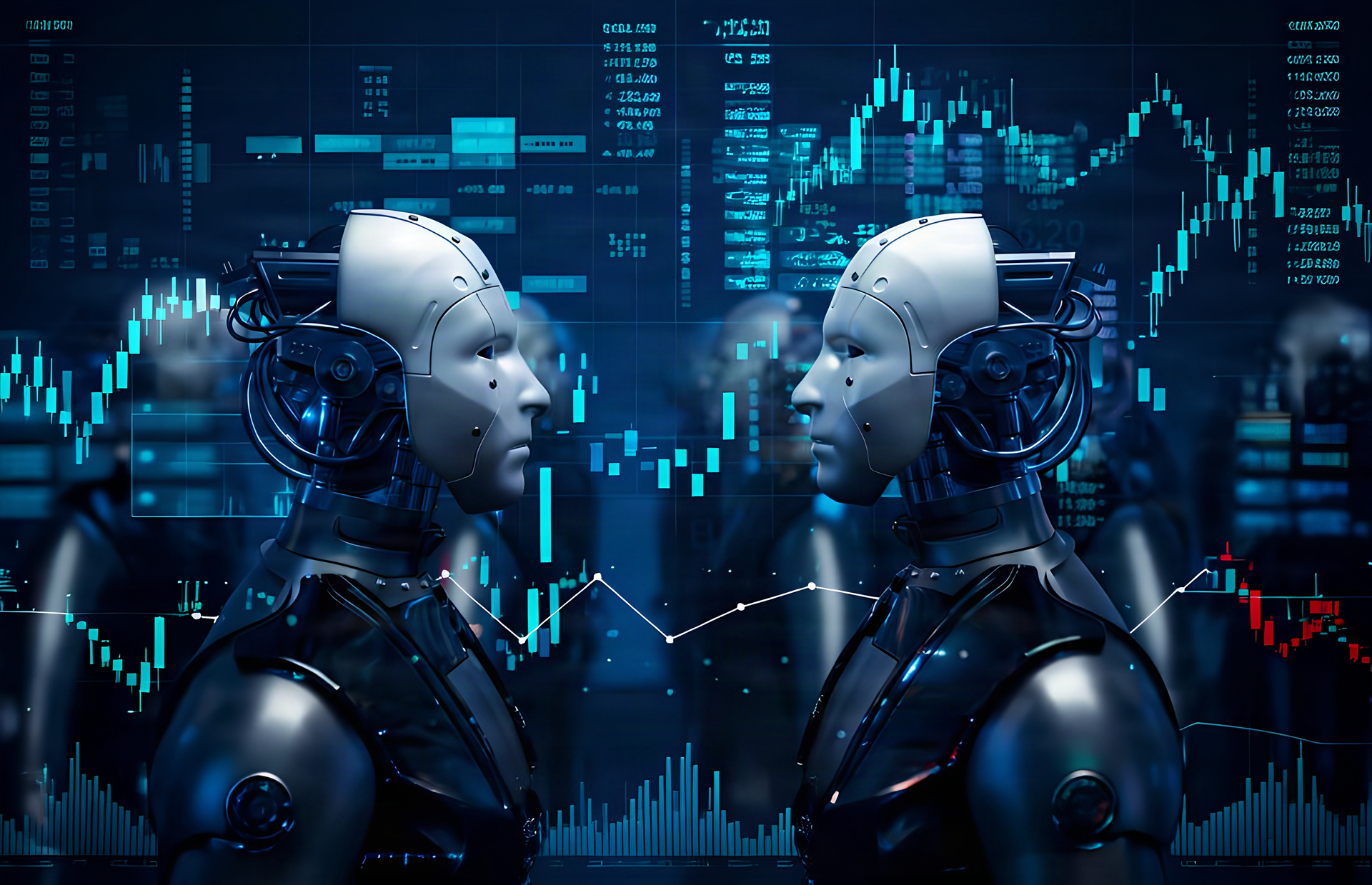
Over the last year, we have shared our future vision of an Autonomous Digital Economy resulting from the convergence of AI/Agents, Blockchain, and the Internet with you. This expands on our earlier investment thesis, which dates back to the launch of our first fund around 2016. It is all about the convergence of powerful new innovations that complete the digitalization of:
Communications and content (Internet)
Commerce and finance (Blockchain-enabled Digital Finance)
Intelligence and work (AI and Agentic)
You can read our prior newsletters, and at minimum we encourage you to watch and reflect upon our Fifth Era Investment Thesis webinar to understand where this is all heading.
Today we are excited to share the highlights of BlackRock's latest report, which joins us in believing in a future enabled by these powerful software technology stacks. BlackRock calls it The Machine-Native Economy, but as you will see, the visions are very similar. BlackRock, as the world's largest investment firm, obviously speaks with a very loud voice, and its conviction drives markets.
So without further ado, let's see what they just published for the world's investors to consider and act upon.
Who is BlackRock?
BlackRock is the world's largest asset manager and one of the most influential institutions in global finance. Its importance to this discussion is not simply its scale. BlackRock sits at the intersection of institutional investing, securities markets, ETFs, money-market funds, and increasingly digital assets. As you may recall, Alison is the former CFO and head of strategy at BGI, and she and Matthew worked on strategizing and launching iShares, which is now BlackRock's largest product family.
So when BlackRock publishes a report arguing that digital assets could become part of the economic infrastructure required by AI, it is worth paying attention, and we do.
The report is not a crypto manifesto, although too many people have missed the forest for the trees in confusing the worst of crypto with the best of digital finance enabled by Blockchain infrastructure. The report's authors include BlackRock's Head of Digital Assets Research, its Head of Digital Assets, and senior iShares executives.
Their argument is fundamentally about the future architecture of financial markets.
AI + Blockchain + Internet = The Machine-Native Economy
In its new report, The Machine-Native Economy: How digital assets connect intelligence, commerce, and compute, BlackRock argues that artificial intelligence and digital assets are beginning to converge.
AI provides machine-native intelligence.
Digital assets provide machine-native money and assets.
Blockchains provide the programmable infrastructure through which intelligent machines can transact.
Sound familiar? This closely parallels Fifth Era's thesis around the Autonomous Digital Economy, and our decades-long investment thesis on the same.
The Internet gave machines global connectivity and access to information.
AI is now giving machines intelligence - the ability to understand, reason, plan, and make decisions.
Blockchain can give machines digital ownership, programmable money, trusted settlement, and the ability to transfer value.
Put the three together and something fundamentally new becomes possible. Software no longer merely communicates information.
Software can:
discover → decide → negotiate → purchase → pay → settle → verify → repeat
BlackRock describes agentic AI as systems capable of carrying out multistep objectives with limited human intervention. Once agents begin acting rather than merely answering questions, they need access to economic infrastructure.
That is the BlackRock Machine-Native Economy, and it is the essence of Fifth Era's Autonomous Digital Economy.
New standards are already emerging:
Anthropic created MCP, allowing AI systems to interact with external tools and data.
Stripe and OpenAI developed the Agentic Commerce Protocol, while Stripe and Tempo have developed the Machine Payments Protocol.
Google developed A2A, enabling agents to interact with other agents.
Coinbase developed x402, allowing machines to make blockchain-based payments over the Internet.
Companies are beginning to build the financial infrastructure for agentic commerce.
How big could this become?
No one yet knows. However, several numbers in BlackRock's report illustrate the potential scale:
AI infrastructure capital expenditure could exceed $5 trillion between 2025 and 2030.
BlackRock cites analyst estimates suggesting that AWS, Microsoft Intelligent Cloud, and Google Cloud alone could generate approximately $1.1 trillion of annual revenues by 2030, growing about 29% annually from 2025.
And inference - AI actually doing work - is expected eventually to exceed model training as the largest AI workload. By 2030, BlackRock's cited projections show inference consuming approximately 43% of global data-center power demand, compared with 28% for AI training.
This matters because inference is transactional.
Every time an autonomous agent asks another model a question, acquires data, or rents computing capacity, an economic exchange could occur.
One person might use one AI agent.
That agent could employ ten specialist agents.
Those agents could make hundreds of API calls and compute purchases.
The number of machine economic interactions could therefore become vastly larger than the number of human economic interactions.
BlackRock does not forecast precisely how many agent transactions will ultimately occur, and we should not pretend that it does.
But its thesis points toward a world in which transaction counts - not simply transaction values - could explode.
Which unicorns could be among the winners?
BlackRock does not provide an investment list. The following is therefore our Fifth Era interpretation of the private companies particularly well positioned if its thesis proves correct.
AI/Agentic leaders
Needless to say, a Machine-Native Economy will naturally benefit the leaders in AI and Agentic software and infrastructure. Given our focus on private investing, the obvious beneficiaries likely include:
Anthropic: Anthropic created MCP, one of the emerging standards connecting AI agents to tools, data, and workflows. If MCP develops into a widely adopted interface between agents and the Internet, Anthropic could occupy an important position within the machine-native stack.
OpenAI: OpenAI is moving beyond generative AI toward agents that can take actions for users. Its involvement with Stripe in agentic commerce points toward a world where AI systems do not simply provide answers; they make purchases and conduct economic activity. OpenAI is reportedly seeking new financing at roughly a $1.4 trillion valuation.
Next-generation recursive LLMs: Whether Anthropic and OpenAI can keep up in the arms race depends partly on their ability to master recursive self-intelligence, which is also true for the public LLMs, including Google/Gemini and SpaceX/AI. Both enabling their LLMs to improve themselves and doing so in ways that are safe and trustworthy become mission-critical. Dario Amodei and Sam Altman have both stated that this is key to long-term success. If they stumble, this may open the door to other unicorns focused on this capability, including the likes of Cognition and Recursive Superintelligence (more on this in an upcoming newsletter).
Other AI-compute unicorns: BlackRock's thesis suggests compute itself could become an investable, financeable, and potentially tokenized commodity. Companies providing AI infrastructure and compute capacity could therefore benefit not only from today's data-center boom, but eventually from machine-managed compute marketplaces. In particular, we are watching the race closely to create new approaches to semiconductor development, including by the likes of DensityAI, Etched, and Kepler Computing.
2. Digital finance leaders
BlackRock makes it very clear in their report that agent-to-agent transactions will massively increase the world's demand for low-cost, high-speed payments infrastructure, in ways that traditional solutions will be unable to serve. They are simply unfit for purpose. Leading beneficiaries of this will likely include:
Stripe: Perhaps the clearest private-market beneficiary. Stripe sits at the intersection of Internet commerce, programmable payments, stablecoins, and AI agents. It co-developed ACP with OpenAI, developed machine-payment infrastructure with Tempo, and in August agreed to acquire OpenRouter, which routes AI usage across more than 400 models. Stripe was valued at $159 billion earlier this year.
Tether: If stablecoins become machine-native money, the largest private stablecoin issuer is clearly strategically positioned. The ultimate winners will depend upon regulation, interoperability, and which stablecoins agents choose to use, but BlackRock's thesis materially increases the potential addressable market for dollar-based digital currencies.
Other digital-asset infrastructure unicorns: Companies providing institutional wallets, custody, security, blockchain APIs, identity, compliance, and tokenization infrastructure could become the middleware connecting AI agents with digital financial networks. Companies like Anchorage, Chainalysis, Kraken, Uphold, and the recent de-SPAC merger company Securitize come to mind. There are many others, of course.
New fit-for-purpose marketplaces leveraging the above innovation to create new-to-the-world ways to participate. Here, names like Kalshi, Hyperliquid, and Polymarket spring to mind, and each is growing rapidly even without the turning on of large-scale agent-to-agent transactions.
This may ultimately prove to be one of the most important categories of all.
The Fifth Era view
To conclude today's newsletter, let's summarize what this means and how it drives our own views and the investments we are making.
There have already been enormous waves of digitalization. Now we are seeing convergence of the three most important drivers of global digitalization:
The Internet digitalized communications and content.
Blockchain is digitalizing identity, trust, assets, and value.
AI is digitalizing intelligence and work.
BlackRock's Machine-Native Economy report is important because it brings these developments together in a new investment thesis from the world's largest and most influential asset management firm.
The future may not simply consist of humans using better software.
It may consist of billions of intelligent software agents interacting with other agents, acquiring information, buying compute, making decisions, exchanging assets, and settling transactions continuously across the Internet.
For that world to function, machines require machine-native financial infrastructure.
That is why the convergence of Internet + AI/Agentic + Blockchain matters, and why we believe digital finance and tokenization will sit at the center of the emerging Autonomous Digital Economy.
We share investment opportunities with our investors regularly. Accredited investors have probably received quite a few emails from us recently, and if not, please let us know so we can update your information.
We encourage you to take a close look. Reach out to us at ir@fifthera.com if you want to learn more about any specific direct investment or our broader AI investment strategy.
Thank you for reading,
The Fifth Era Partners
ABOUT FIFTH ERA
'Focused on Innovation'
Our firm believes we are entering a period of unprecedented innovation, which we call the Fifth Era, and every industry and business will be dramatically impacted. We focus on investing in these new innovations, especially private companies focused on the convergence of Internet, AI/Agentic and Blockchain technologies to shape an Autonomous Digital Economy. Our investment strategies construct portfolios of hard-to-access early stage funds and make concentrated direct investments into emerging category leaders during their mid and late stage investment phases. Fifth Era's investment strategies are now in their 13th year and to date we have invested in a combined portfolio of 1,500+ companies including 80+ unicorns. In the US we are a SEC registered investment advisor, in the UK a FCA appointed representative and our funds are registered in Switzerland.
Visit us at www.FifthEra.com to learn more.
Note: SEC Registration does not imply a certain level of skill or training.