
Demystifying the AI Stack: Where Value Will (Actually) Be Created

Before we dive into this week's AI Access newsletter, we want to take a moment to express our appreciation for this community. During the holidays, it is pretty standard practice to mention how grateful we are for one another and that cannot be more true for us at Fifth Era Partners.
As the world changes, so too does the technology that supports and encourages that change. Without this community of inquisitive minds, we would not be able to fund the new innovations that are pushing us into the Fifth Era. Thank you for being a champion of a tech revolution that is shaping the future.
Demystifying the AI Stack: Where Value Will (Actually) Be Created
If the last year of AI headlines has felt overwhelming, you are not alone.
Every week brings a new model release, a new unicorn, or a new claim that THIS is the company that will “own AI.” The result is often a fair bit of confusion, especially for investors trying to understand where durable value will be created over the next decade.
So we’d like to try and demystify this space and the current moment as much as possible.
At Fifth Era, we think about AI as a stack, similar to traditional tech. And we believe that most of the value across this stack has not yet been generated – that we are still in the first inning of a nine-inning game when it comes to this technology.
We will first explore the different layers of the stack…
Application
Model
Infrastructure
…and then highlight why we’re still early and what we look for in terms of defensibility.
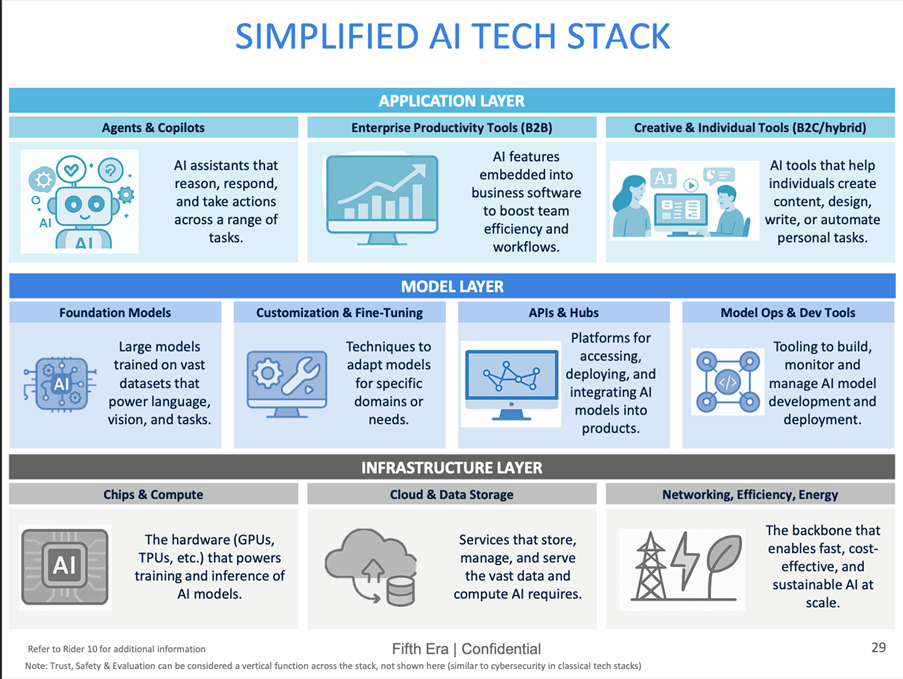
Application Layer: The Real World Solutions
This is the layer of AI most people interact with - the tools that sit directly in front of users. It is very easy to dissect this layer to the n’th degree, but we broadly think about it in three buckets:
Agentic AI
These are AI systems that act on our behalf: reasoning across tasks, using tools, and increasingly making decisions. Agentic systems are still nascent - today there are some impressive use cases, but these aren’t fully robust or autonomous – humans are still very much in the loop of decision-making for a variety of safety and compliance reasons. But long-term, they will sit at the centre of how we work, shop, travel, build, and manage our lives. For that to happen, vast supporting infrastructure still needs to be built: interoperability with enterprise systems, permissions, memory, reliability, and trust – all of this comes into play when we look at the model layer.
Enterprise Productivity (B2B)
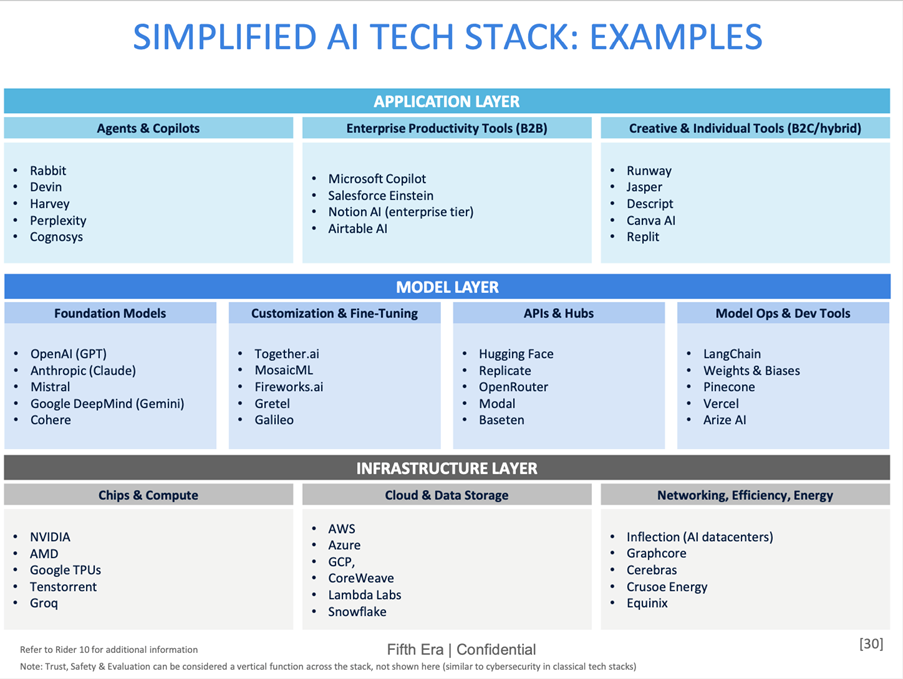
AI embedded directly into workflows people already use: Microsoft Copilot, Salesforce Einstein, Notion AI, Airtable AI. This is where early real revenue is already showing up – and thus where the largest near-term investment trend tends to focus - but enterprise adoption is also still in early days. Most companies are experimenting, but have yet to see true ROI from the solutions they’ve invested in. This isn’t an issue of the tech itself, it’s an issue of deployment in the corporate context, and overcoming inertia.
Creative & Individual Tools (B2C / Hybrid)
Tools like Runway, Canva AI, Jasper, Descript, and Replit help individuals do any number of things, from creating content to coding, automating manual workflows like note-taking, and beyond. These tools show how quickly AI can unlock creativity - but also how competitive and fast-moving this layer is.
A note about what is often missed: physical AI and robotics are in this layer, too. Companies like Figure, 1X, and Apptronik are applying intelligence to the physical world - arguably one of the largest markets ahead.
Model Layer: The Brains & Wiring
This layer is often misunderstood as ‘just LLMs’. In reality, it’s an entire ecosystem of solutions and products that help those ‘brains’ becoming interoperable with the application layer sitting on top of it. In old tech world, this was called “middleware”.
Foundation Models / LLMs: the big names most people are familiar with, including OpenAI, Anthropic, Google DeepMind, Mistral, Cohere… these are capital-intensive, high-stakes businesses pushing the frontier of intelligence. These models are trained on vast mixtures of data - public, licensed, synthetic - transformer architectures and enabling them to have a broad number of capabilities: reasoning, generation of text/images, making inferences, etc.
Customization & Fine-Tuning: most real-world use cases (in the app layer) require adapting foundation models to specific industries, datasets, user types of workflows. Companies like Together.ai, MosaicML, Fireworks.ai, and Galileo sit here.
APIs & Hubs: these are the platforms that developers use to access the foundation models and build on top of them. Solutions like Hugging Face, Replicate, OpenRouter, Modal, and Baseten sit here, and make the LLMs accessible and deployable.
Model Ops & Dev Tools: these are the tools required to build, test, monitor, and scale AI systems in production. Companies like LangChain, Weights & Biases, Pinecone, Vercel, Arize sit here.
This layer will increasingly capture enormous value as AI systems scale.
Infrastructure Layer: The Picks & Shovels
This is not to be confused with “model infrastructure” which sits in the model layer – instead, it’s the physical backbone of AI. It includes elements like:
Chips & Compute: NVIDIA, AMD, Google TPUs, Cerebras, Groq. Compute remains a binding constraint and is certainly not a solved problem.
Cloud & Data Storage: large players like AWS, Azure, GCP, CoreWeave, Lambda Labs, Snowflake. AI is reshaping cloud economics at the moment.
Networking, Efficiency & Energy: data centers, power, cooling, and networking are becoming strategic assets. Companies like Equinix and Crusoe Energy are addressing the energy component of the AI equation, and demonstrate that this is not purely a software play.
Why We’re Still Early (Very Early)
A few underappreciated reasons:
~90% of the world’s data is private, locked behind corporate firewalls and silos. Foundation models are largely trained on public data. Unlocking private data safely and usefully is still ahead of us.
Agentic systems aren’t fully ready yet. When they are, they’ll require new layers of infrastructure, security, and coordination to safely and effectively make decisions on our behalf, interact with the internet and other existing software and tools, etc.
Enterprise adoption is still early. Most companies are piloting or do not yet have AI fully in deployment. Investment has certainly picked up but is still emerging.
Entirely new industries haven’t formed yet. Historically, platforms create businesses we can’t yet name – similar to what we saw with the internet. (We can only hypothesize what these will be – we personally see a lot of white space at the intersection of AI and human interaction as this technology becomes more embedded in our day to day lives).
Regulation, trust, and reliability will reshape how AI is built and deployed – this will create both friction for some innovation in terms of pace and potential, but also a large opportunity for solutions that cover the safety and security space.
Our Eye on Defensibility Above All
At Fifth Era, we don’t just invest in managers or companies because they are ‘AI’. That lens is noisy and often driven by hype. Our focus is on a very critical question: is the business defensible and positioned to win over the long term?
We look for:
Proprietary or private data: companies that have exclusive access to valuable data, which is akin to land in the new AI gold rush
Deep workflow embedding: tools that sit where the users are, and are integrated into daily operations. This is especially true in enterprise AI where behaviour change is otherwise very slow
Systematic lock-in over time: solutions that have accumulated context, preferences or history over time – this becomes a compounding source that creates lock-in with customers
Brand wedges and trust: trust is a highly competitive advantage in a space that is so flooded with new tools. Products that are reliable, safe, accurate, and preserve privacy can wedge their brand and hold it.
Network effects that compound: things like more users à more feedback into the system. More data à constantly improving model. And so on. This creates a reinforcing cycle where winning early can mean winning into the future.
AI is not a single market, and despite the rise of powerful incumbents in the LLM space, it is far from ‘too late.’ This is a multi-layered ecosystem that will expand and evolve for decades. We are still at the beginning.
Thank you for reading.
Tallulah Le Merle
AI Access Partner
About Fifth Era
We are entering a period of unprecedented innovation we call the Fifth Era, and every industry and business will be dramatically impacted. We focus on investing into these new innovations. Fifth Era specializes in investment strategies which construct portfolios of hard-to-access funds and direct investments through our investment strategies - AI Access and Blockchain Coinvestors. Fifth Era's investment strategies are now in their 12th year and to date we have invested in a combined portfolio of 1,500+ companies and projects including 80+ unicorns. In the US we are a SEC registered investment advisor, in the UK a FCA appointed representative and our funds are registered in Switzerland. Visit us at www.FifthEra.com to learn more.
SEC Registration does not imply a certain level of skill or training.
“Focused on Innovation”