
How Did Prediction Markets Perform in the Midterms?
How Did Prediction Markets Perform in the Midterms?
Why the U.S. midterms may be the clearest test yet of whether prediction markets can outforecast the experts.
In this issue
Why focus on prediction markets? - Two potential benefits we see in these platforms: new ways to hedge risk and new sources of information about future events
What is a prediction market? - How event contracts work, with an example of how an airline might use them to hedge political risk
Predictive value: The U.S. midterms - What third-party studies found about how Kalshi and Polymarket performed relative to forecasting models, including where the markets fell short
Prediction markets poised to play a greater role - A view on the role prediction markets may play in future financial infrastructure, along with the limitations to keep in mind
In this week’s Letter from London, we return to a theme we have discussed in the past, and which is the subject of many a discussion in the European markets and especially here in the City of London. A new type of marketplace has arisen over the last handful of years. It seems as if everyone is talking about them, from financial theorists and investment practitioners on the one hand, to the many out for a chance to trade on the information they have, or believe they have.
These are the prediction market platforms where participants trade contracts on future events, using market prices to estimate the probability of outcomes.
In today’s newsletter, we take a close look at the performance of the prediction markets around the U.S. midterm elections as a measure of how accurate they are becoming. This is important, not least because almost every market that we have is ripe for disruption if this new type of market is superior in predicting outcomes.
Let’s get started.
Why focus on prediction markets?
The recent U.S. midterms were a test for an increasingly prominent part of the financial world: prediction markets.
Millions of people have become familiar with companies such as Kalshi and Polymarket, where users trade on everything from elections to economic announcements. Their prices increasingly feature alongside polling and expert commentary, offering a continuously updated answer to a simple question: what does the market think will happen?
At Fifth Era, we believe the growth of these platforms deserves attention for two reasons.
First, prediction markets can expand the range of risks that people and businesses can manage or hedge. Said differently, the landscape for derivatives now can extend beyond underlying financial assets to nearly all events in the world.
Second, they may also improve how we gather and interpret information about the future. In other words, they may prove more predictive than existing forms of estimation.
The United States midterm elections provided an opportunity to examine that second proposition. How well did the markets perform, and did putting money behind a prediction produce a better forecast?
Disclosure: Fifth Era is actively investing in prediction markets and may hold direct or indirect exposure to the companies discussed here.
What is a prediction market?
Before looking at the results, it helps to understand what is being traded.
A typical prediction market offers a contract on a clearly defined outcome, such as whether a candidate will win an election. A “Yes” contract pays $1 if the candidate wins and nothing if they lose.
Buy that contract for 60 cents, and you stand to make 40 cents or lose your 60 cents, before fees. Alternatively, you could buy the “No” side for approximately 40 cents, effectively selling short, and earning 60 cents if the candidate loses.
The price emerges from people trading with one another. A contract trading at 60 cents is therefore commonly read as the market assigning a 60% chance to that outcome.
This will sound familiar to anyone who has used derivatives. A futures contract derives its value from something else, such as the future price of oil. An event contract applies a similar principle to a specified real-world outcome.
That connection helps explain why we find the industry interesting.
Take this real-world example:
An airline can use fuel derivatives because an unexpected rise in fuel costs in the future could damage its business. Hedging (or buying jet fuel futures) allows it to secure greater certainty over future costs. Ryanair, for example, recently reported that it had hedged 80% of its jet fuel through March 2027, helping protect its earnings from oil price volatility associated with the recent Iran war.
But fuel is only one of the uncertainties an airline faces. What if Ryanair could also hedge out other risks?
Imagine an upcoming election in Spain where one leading party proposes restrictions on tourism that could reduce demand for flights. For instance, it could do so by increasing taxes on airlines or hotels, or visa fees.
An airline like Ryanair, with substantial flights to and from Spain and therefore exposure to the risk of decreased demand associated with the election, could theoretically buy a contract that pays out if that party wins. A political outcome that damages its business would also generate a payment that helps absorb the loss.
The protection would be imperfect: winning an election does not guarantee a policy will be implemented, and predicting demand is always tricky. Nevertheless, it illustrates how prediction markets could make previously difficult risks easier to manage.
There are already practical examples. Zest, a tea business, reportedly used a Kalshi tariff contract whose payout offset part of its lost sales to a Canadian customer.
Predictive value: the U.S. Midterms
The other potential benefit is the information these markets produce.
The argument is straightforward. People with better information have an incentive to trade when they believe the price is wrong. Their trades move the price, incorporating that information into a signal everyone else can observe.
Real money gives participants a reason to care about accuracy. It does not eliminate mistakes, enthusiasm, or herd behaviour. The midterms offered evidence of both the strengths and the limitations.
While we are still early in studying prediction markets, several third parties have already looked at how they performed in the midterms, vs. traditional forecasts.
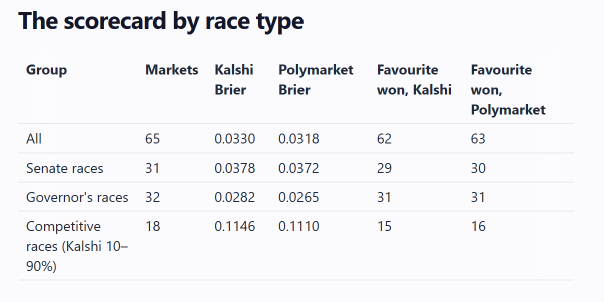
Predict Desks examined 65 settled markets covering Senate races, governors’ races, and control of Congress, using prices at 6 p.m. Eastern on Election Day.
They found that Kalshi’s favourites won 62 of the 65 markets, while Polymarket’s favourites won 63 of 65.
Source: Predict Desks
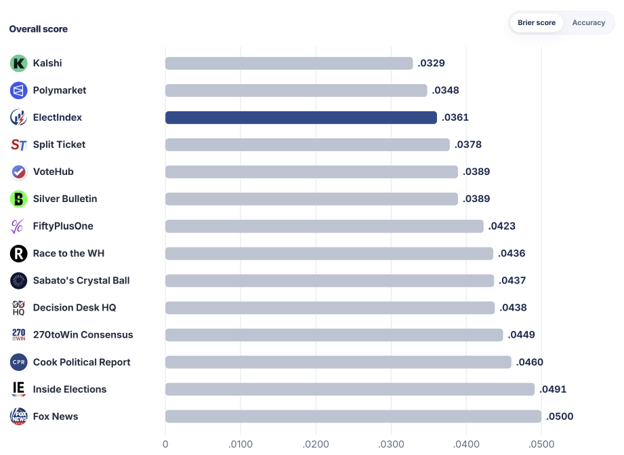
A Brier score measures how closely forecast probabilities match outcomes. Lower is better, and confident mistakes are penalised more heavily. On this sample, both platforms performed well, with a small advantage for Polymarket.
A separate assessment by ElectIndex placed Kalshi and Polymarket ahead of the forecasting models it compared on overall Brier score. Kalshi ranked first in that assessment. Different samples and observation times can change the ranking, so we would avoid declaring either platform the definitive winner.
Source: ElectIndex
There was also a common weakness. In Predict Desks’ 18 competitive markets, Democrats won 15, or 83%, despite an average Democratic price of 61.7% on Kalshi. The markets anticipated Democratic strength but underestimated how far it would extend. Many of the other markets covered safe races, which helped flatten the overall results.
Does this mean prediction markets are better than polling?
That comparison needs care. A poll estimates voter support. A prediction market prices the chance of winning. A candidate with 51% support could have a much higher than 51% probability of victory, depending on the uncertainty around that estimate.
The more useful comparison is with forecasting models, which also estimate the probability of an outcome.
Those models and markets are closely connected. Traders use polls and forecasts to inform their decisions. Nate Silver, a notable forecaster, argues that his model identified the strength of the Democratic position earlier, with prediction markets subsequently moving towards it. He also acknowledged that markets reacted impressively quickly once results began arriving.
Both can be true. A market can be an effective way to aggregate information while depending heavily on the people who produce it.
Brazil’s presidential election offered another reminder to read probabilities carefully. On the eve of the runoff, Polymarket’s Flávio Bolsonaro contract traded at approximately 83 cents. Lula won with roughly 51.8% of the vote.
That was a painful result for those backing the favourite. But an 80% probability still leaves a one-in-five chance of the alternative. We should expect credible forecasts to include surprising outcomes.
Predictive markets poised to play a greater role
For us, the midterms strengthened the case that prediction markets can produce useful information. They also demonstrate why that information should be assessed alongside polling, models, and the underlying evidence.
Even more exciting for us is the potential for this predictive power to extend to other markets and events. And since every marketplace is potentially about to be disrupted by this new innovation, enormous value may accrue to the leaders of this space, including Kalshi and Polymarket as well as others getting started now.
As more uncertainty becomes tradable, businesses may gain new tools to manage risk, and the resulting prices may help others make better decisions.
That combination - new ways to transfer risk and new ways to understand it - is why we believe prediction markets could become an important part of the next generation of financial infrastructure.
Thank you for reading,
Mitch Mechigian
Partner, Fifth Era UK, London
ABOUT FIFTH ERA
'Focused on Innovation'
Our firm believes we are entering a period of unprecedented innovation, which we call the Fifth Era, and every industry and business will be dramatically impacted. We focus on investing in these new innovations, especially private companies focused on the convergence of Internet, AI/Agentic and Blockchain technologies to shape an Autonomous Digital Economy. Our investment strategies construct portfolios of hard-to-access early stage funds and make concentrated direct investments into emerging category leaders during their mid and late stage investment phases. Fifth Era's investment strategies are now in their 13th year and to date we have invested in a combined portfolio of 1,500+ companies including 80+ unicorns. In the US we are a SEC registered investment advisor, in the UK a FCA appointed representative and our funds are registered in Switzerland.
Visit us at www.FifthEra.com to learn more.
Note: SEC Registration does not imply a certain level of skill or training.